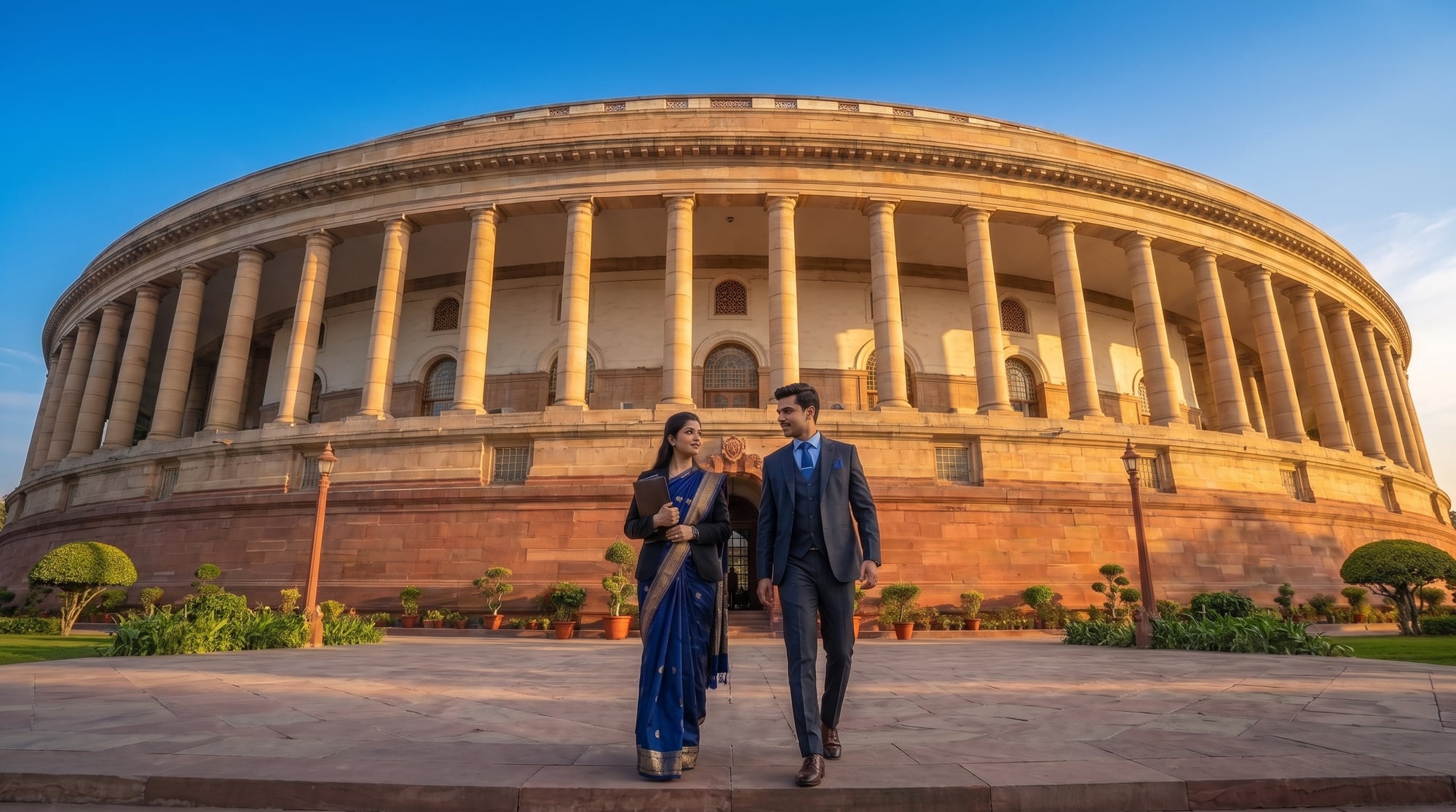
In India, it is almost always election season somewhere. While Uttar Pradesh campaigns, Kerala counts votes, while Bihar revises its electoral rolls, Bengal is already mid-contest. The country's 28 states and 8 Union Territories each run on their own electoral clock, ticking towards dissolution dates that rarely align. "One Nation, One Election" (Ek Rashtra, Ek Chunav) asks a deceptively simple question: What if every clock in the room were reset to strike together?
A Nation That Once Kept One Time
The ideology of “One Nation, One Election” is not new. In fact, it is closer to a memory. Between 1951-52 and 1967, India's general and state assembly elections were held together, a rhythm broken only after the premature dissolution of several assemblies in 1968 and 1969 that eventually fragmented the cycle. A Parliamentary Standing Committee revisited the question in 2015 and the Law Commission floated a draft framework in 2018. The debate gained real momentum in September 2023, when the government constituted a High-Level Committee under former President Ram Nath Kovind, whose 8 members included Union Home Minister Amit Shah and Congress leader Ghulam Nabi Azad. On 14 March 2024, the committee submitted an extensively comprehensive 18,000 page report recommending simultaneous Lok Sabha and Assembly elections to be followed by panchayat and municipal polls within 100 days.
Synchronization
The arguments for electoral synchrony largely revolve around money and attention. While the Union government alone spends an estimated ₹4,000 crore on a single Lok Sabha election, the Election Commission projects that a fully synchronized electoral cycle would require roughly ₹7,951 crore, which is almost double the amount spent on a single Lok Sabha Election. P.P. Chaudhary, chairman of the Joint Parliamentary Committee, carefully examined the proposal and has claimed that synchronized elections could eventually unlock savings of nearly ₹7 lakh crore and lift GDP growth by approximately 1.6%. Moreover, he argues that the funds could be seamlessly redirected to infrastructure and welfare of the citizens. A single, common electoral roll would abolish structural redundancies such as the duplication of maintaining separate lists for every tier of government. Chaudhary argues it could possibly lift voter turnout too, particularly among migrant workers who often cannot make separate trips to home for fragmented and asynchronous election polls. Supporters also point out a hidden cost: because some part of India is almost perpetually under the Model Code of Conduct, policy announcements are routinely paused, chronically draining the state capacity since teachers, police personnel and civil servants are repeatedly pulled off from their regular duty to participate in the election work.
Whose Time Is It Anyway? The Case for Caution
Critics do not dispute that Indian elections are frequent; they dispute that frequency is the problem. State elections often turn on local grievances, be it drought relief or unemployment. Opponents warn that once campaigns merge, national issues tend to overshadow state concerns, thereby giving wellresourced national political parties a natural advantage over their regional counterparts. The Congress has astutely critiqued the proposal, labelling it "One Nation, No Election", exposing a critical structural vulnerability - If a state government collapses mid-term, the Kovind Committee's own "unexpired term" formula would only give its successor the remainder of the original five-year clock. Congress leader Digvijaya Singh has strongly challenged the efficacy of this clause and denounced this framework as functionally unworkable for a state left mid-crisis. Others question whether frequent polls are really the flaw, arguing that facing voters more often is a democratic safeguard, not an inefficiency. The numbers add further doubt - Election Commission projections suggest security force deployment must rise by roughly 50% by 2029, alongside lakhs of additional EVMs and hundreds of new warehouses. On the other hand, critics separately note that Union Election spending amounted to under one-tenth of 1% of the total government expenditure between 2019 and 2024. This raises serious questions about how transformative the promised savings truly are.
Where the Clock Stands Today
The Constitution (129th Amendment) Bill, was introduced in the Lok Sabha on 17 December 2024, clearing a division vote 269 to 198 and subsequently forming a nearly 40 member Joint Parliamentary Committee. Nearly nineteen months after its inception, the committee is still touring the country. As of July 2026, it has yet to consult 18 states of India. Its own chair has conceded that the bill is unlikely to return to Parliament this Monsoon Session. Government leaders have floated implementation timelines ranging from the 2029 general election to as late as 2034. This fact is itself a reminder that constitutional change in a prominent democracy like India moves at the pace of consensus, not decree.
Why Young India Must Help Set the Time
This is precisely the debate that should not be left to Parliament alone. Many first-time voters will cast their earliest ballots inside whichever electoral system ONOE (One Nation, One Election) leaves behind, inheriting either its efficiencies or its unresolved fractures. Yet, public conversation on the reform frequently narrows down to two competing slogans: "efficiency" versus "authoritarianism". It actually demands the harder work of reading the Kovind report, following the Joint Parliamentary Committee's proceedings and weighing genuine trade-offs between cost and federalism, stability and accountability. That is the real invitation inside this debate: not to pick a side by instinct, but to practice the evidence-based, analytically rigorous citizenship the world's largest democracy needs most from the generation that will live longest with its outcome.
Resetting every clock in a room to the same hour takes only a decree. Convincing everyone in the room that it is now the right time takes something else entirely that no decree can ever can: It is the immense patience, trust and the willingness to listen across the political barrier. Afterall, no bill number and no division vote can measure that. It is the real test "One Nation, One Election" sets before Indian democracy.