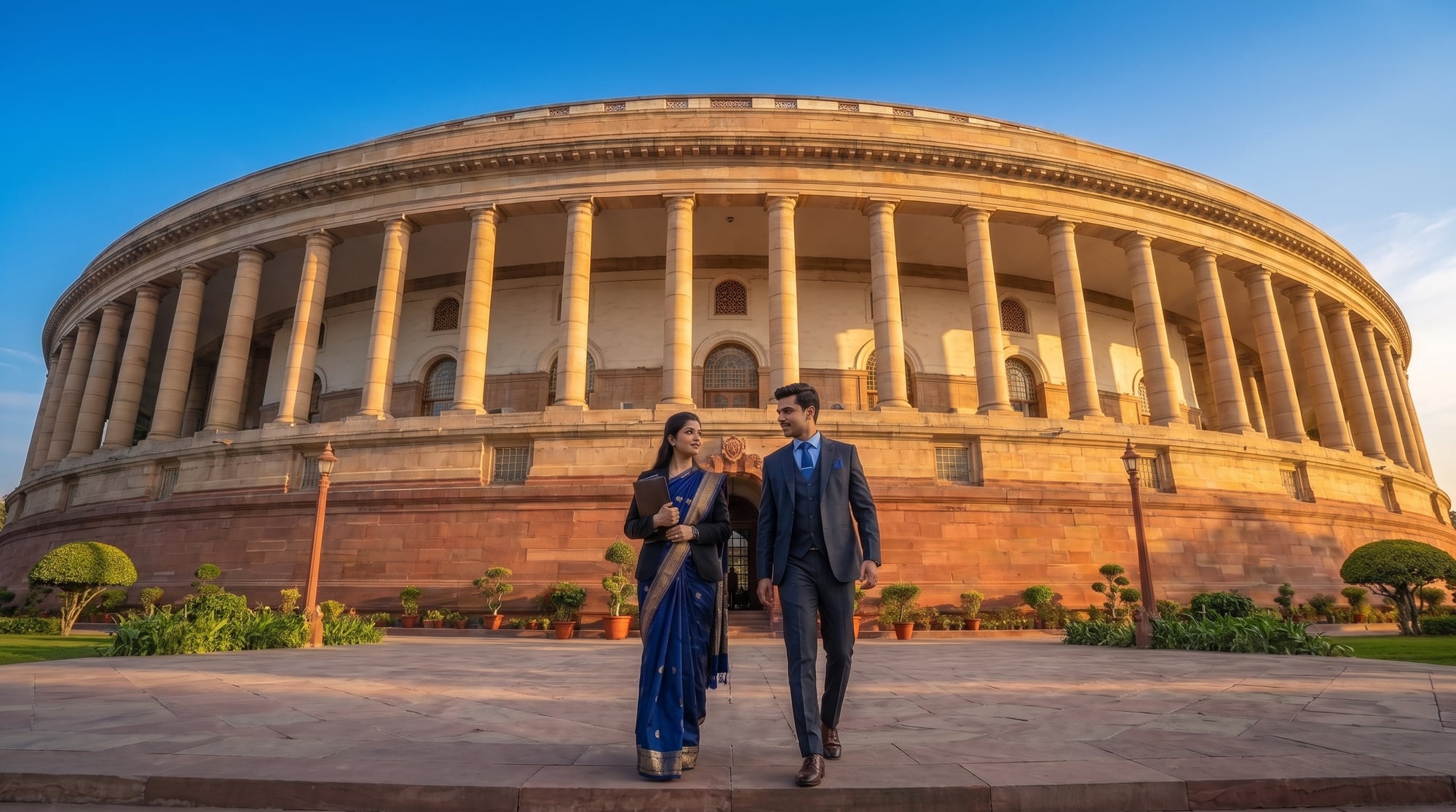
A Village, Five Elections, One Exhausted Booth Officer
Aarav is one of the most promising young schoolteachers in his district in Uttar Pradesh the kind of teacher parents specifically request, whose students have started topping the block-level science exams. He's been at it for eighteen years. In just the last five, he has been pulled out of his classroom six times twice for Lok Sabha duty, once for the state assembly election, twice for panchayat polls, and once for a civic body by-election after a sitting corporator resigned. Each time, his students lose weeks of instruction. Each time, the local administration freezes new welfare announcements because the Model Code of Conduct has kicked in somewhere in the state. Each time, buses of central police personnel roll through his town, exhausted from an election cycle that never really ends.
Aarav isn't a policymaker. He's just one of the millions of ordinary Indians teachers, clerks, police constables whose lives are quietly rearranged every time India goes to the polls. And in a country where an election is happening somewhere almost every few months, that's often.
This is the everyday reality that "One Nation, One Election" (ONOE) promises to fix. It's also the reality that its critics say the proposal misunderstands entirely.
Where It All Began
It's easy to forget that simultaneous elections aren't a new idea for India they were the original design. From 1952 to 1967, Lok Sabha and state assembly elections ran together like clockwork, across four full general election cycles. The rhythm broke only because assemblies started collapsing mid-term: Kerala's government was dismissed in 1959 amid political and religious opposition, Haryana's assembly fell apart in 1968 due to defections, and Indira Gandhi dissolved the Lok Sabha early in 1971 to consolidate power after the Congress split. One disruption after another, and by the 1970s, India's electoral calendar had permanently fractured into the staggered mess we know today. The idea of stitching it back together first resurfaced formally in a 1983 Election Commission report, then again in the Law Commission's 1999 report under Justice B.P. Jeevan Reddy. It gained real political momentum after 2016, when the idea was revived at the highest levels, leading eventually to the Kovind Committee of 2023-24 and the Constitution (129th Amendment) Bill, 2024 the legislative vehicle now attempting to reset India's electoral clock.
The Case for Syncing the Calendar
The numbers proponents lean on are eye-catching. The 2024 General Election reportedly cost around Rs 1.35 lakh crore more than double the roughly Rs 60,000 crore spent in 2019. The Joint Parliamentary Committee reviewing ONOE has suggested that fusing Lok Sabha, assembly, and local body elections could save close to Rs 7 lakh crore by eliminating duplicated spending on security, transit, and logistics.
Then there's the human cost. An Economic Advisory Council to the Prime Minister working paper estimated that synchronised elections could cut the deployment of polling personnel by nearly 28% roughly 26 lakh people over a five-year cycle freeing up over a crore of personnel-days that could otherwise go back into classrooms and public offices. Add to that the argument about "policy paralysis": in high-population states like Uttar Pradesh or Maharashtra, where different tiers of elections land in different years, governments can spend four to six months a year operating under an MCC freeze that blocks new schemes and capital announcements.
Supporters, including Kovind Committee member Harish Salve, have pushed back on some of these fears arguing that the MCC doesn't stop the implementation of existing programmes, only the launch of new ones, and only in states actually going to the polls. Still, the appeal of one predictable fiveyear window, rather than a rolling freeze, is central to the pitch.
The Case Against Rushing the Clock
But critics argue the savings story is thinner than it looks. Election-related spending, even at its 20192024 peak of around Rs 16,255 crore a year, works out to roughly 0.09% of total Union government expenditure a rounding error, not a fiscal crisis. The bigger, murkier problem is unaccounted political cash, estimated at over Rs 1,00,000 crore in the 2024 election alone money that a synchronised calendar doesn't eliminate, critics say, so much as concentrate into a single, larger surge. The deeper worry, though, is constitutional and political, not financial. The Supreme Court's 1973 ruling in Keshavananda Bharati,held that free elections and parliamentary democracy are part of the Constitution's unamendable "basic structure." Squeezing state assembly terms to fit a national fiveyear rhythm under the new Article 82A's "unexpired term" formula cuts directly against the framers' original intent in Articles 83 and 172, which barred extending or truncating a legislature's term without a fresh mandate.
There's also the wave effect,the tendency of voters, when casting ballots for Parliament and state assembly on the same day, to favour the same large national party at both levels. Data cited in policy debates shows regional parties' vote share climbing from roughly 8% in the early decades of independence to about 23% by 2019, even as national parties' combined share slipped from 76% to under 69%. Critics fear ONOE could reverse that hard-won regional voice, burying local concerns flood relief in Assam, agrarian distress in Vidarbha, coastal livelihoods in Kerala under nationally dominant campaign narratives.
And then there's the practical mountain: the Election Commission estimates the country would need roughly 46.75 lakh Ballot Units, 33.63 lakh Control Units, and 36.62 lakh VVPATs to run every tier of election at once machinery that doesn't yet exist at that scale.
What the Courts Have Said
Indian courts have shaped this debate long before ONOE became a headline. The 1973 Kesavananda Bharati ruling, already mentioned, is the anchor, it declared that free and fair elections form part of the Constitution's basic structure, a line even a constitutional amendment cannot cross. Supporters of ONOE argue that synchronising the calendar doesn't touch that principle at all it only changes when those free and fair elections happen, not whether they happen.
Then there's S.R. Bommai v. Union of India (1994), the case that defined how far the Centre can go in dismissing state governments and imposing President's Rule. Proponents of ONOE point to Bommai's emphasis on protecting the sanctity of an elected government's mandate as proof that synchronisation, done carefully, actually reinforces democratic stability rather than undermining it. Critics read the same judgment the opposite way as a reminder that state governments have an independent democratic mandate that a national election calendar shouldn't be allowed to override or dilute.
A third judgment, often invoked by critics rather than supporters, is Mohinder Singh Gill v. Chief Election Commissioner (1978), which affirmed the Election Commission's sweeping constitutional authority under Article 324 to ensure elections are free and fair. Critics argue this authority is precisely what's being under-used today: the Model Code of Conduct that ONOE is partly designed to shrink has no statutory teeth at all. It can advise, but it cannot penalise a gap flagged by the Goswami Committee back in 1990 and repeated by a Parliamentary Standing Committee in 2013, with little having changed since. Instances of alleged MCC violations by leaders across the political spectrum in recent election cycles, critics say, show a code that's routinely stretched and rarely enforced which they argue is a problem of accountability, not of election frequency.
Voices from the Critics Side
Beyond the courtroom, the critique of ONOE is as much political and philosophical as it is legal. Some commentators argue that the entire "policy paralysis" framing is a red herring pointing out that the MCC blocks only new scheme launches, and only in states actually voting, not governance itself. Others note that election spending, at under a tenth of one percent of Union expenditure, is simply too small a line item to justify a constitutional overhaul; the real drain, they argue, is unaccounted political cash, which a synchronised calendar concentrates rather than cures.
A recurring theme among critics is that frequent elections aren't a bug but a feature they act as a running feedback loop between citizens and government. The scramble to fix implementation problems after 2016's demonetisation, or the quick course correction on GST in 2017, both came, critics point out, with state elections just months away. Compress that feedback into a single five-year window, the argument goes, and governments may simply have far less incentive to course correct in real time.
There's also a sharper, more institutional critique: reform commissions have repeatedly proposed fixing the machinery around elections rather than their frequency. The Law Commission's 255th Report (2015) called for criminalising paid news and surrogate advertising. The Umesh Sinha Committee (2019) recommended extending the 48-hour pre-poll "silence period" to social media and OTT platforms. Critics argue that until these recommendations are implemented and until fast-track tribunals exist to punish violations within months rather than after the next election cycle no amount of calendar synchronisation will fix the underlying integrity gaps in Indian elections. So, Can India Vote Less Often?
Maybe the honest answer is that ONOE isn't really a debate about the frequency of elections at all it's a debate about what Indian democracy is for. Is it a machine to be made efficient, or a conversation to be kept alive? Aarav, pulled from his classroom one election at a time, would probably welcome fewer disruptions. But he might also worry about a ballot that stops asking him, separately, what his village needs.
Between administrative exhaustion and federal anxiety lies the real work ahead: not choosing efficiency over democracy, but designing a calendar through consensus, phased rollout, and institutional safeguards like a constructive vote of no-confidence that can hold both at once.