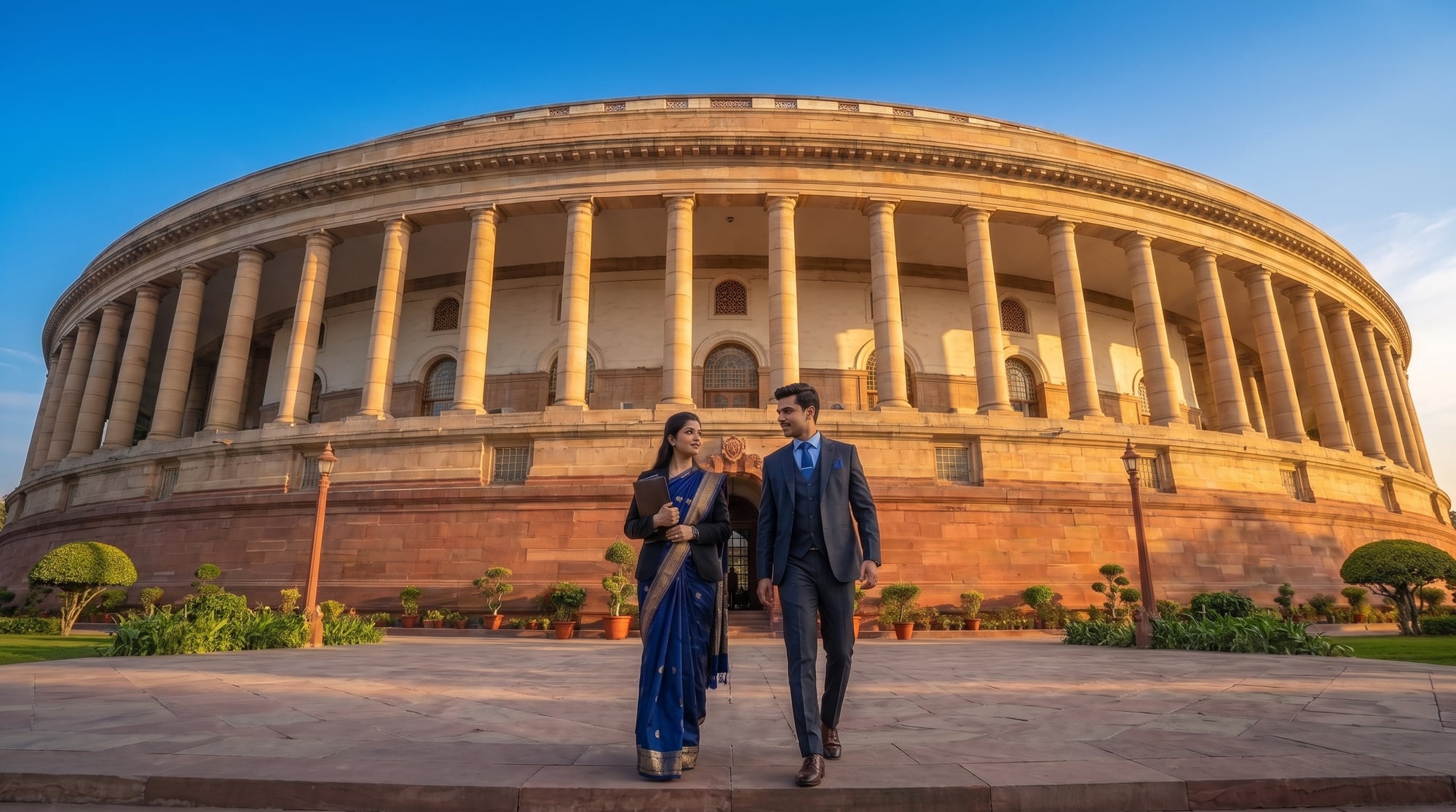
India exercises democracy so often that it has almost stopped noticing. Every year, between five to seven State Assemblies participate in polling, and since 1952, the Election Commission of India (ECI) has conducted more than 400 elections to the Lok Sabha and State assemblies.1 The world’s largest democracy in the world finds itself mired in perpetual campaigning. The Constitution (129th Amendment) Bill, 2024,2 now being examined by a Joint Parliamentary Committee (JPC), asks an ostensibly question: should India vote together? How we respond will determine the very foundation of our republic for the coming hundred years.
RETURN, NOT A RUPTURE
Critics often view “One Nation, One Election” (ONOE) as a new centripetal move, a centralising project designed to homogenise a diverse polity. Simultaneous elections to the Lok Sabha and the State Assemblies have been the core principle of the Indian Republic, held successfully in 1951-52, 1957, 1962 and 1967. The cycle was disturbed only when premature dissolutions of various Assemblies in 1968-69, as well as the Fourth Lok Sabha in 1970, decoupled the national and state timetables.3 The move to bring about the synchronisation of the two has been widely recommended for decades. It has been recommended by the 170th Law Commission Report (1999), the Parliamentary Standing Committee’s 79th Report (2015), NITI Aayog (2017) and, more extensively, the High-Level Committee (HLC) chaired by former President Ram Nath Kovind.4 This 18,626-page report was prepared after taking into account more than 21,500 public responses—about 80 per cent in favour—and views from 47 political parties, of which 32 backed the reform, and 15 opposed it. The Union Cabinet accepted the report in September
Press Information Bureau, Ministry of Law and Justice, Gov’t of India, One Nation, One Election, Pʀᴇss
Iɴꜰᴏʀᴍᴀᴛɪᴏɴ
Bᴜʀᴇᴀᴜ (Dec.
17, 2024), https://www.pib.gov.in/PressReleaseIframePage.aspx?PRID=2085082®=48&lang=2. PRS Lᴇɢɪs. Rsᴄʜ., The Constitution (One Hundred and Twenty-Ninth Amendment) Bill, 2024, PRS Iɴᴅɪᴀ (last visited July 15, 2026), https://prsindia.org/billtrack/the-constitution-one-hundred-and-twenty-ninth-amendmentbill-2024. Press Release, Press Information Bureau, Ministry of Law and Justice, Gov’t of India, One Nation, One Election (Dec. 17, 2024), https://www.pib.gov.in/PressReleaseIframePage.aspx?PRID=2085082®=48&lang=2. Press Release, Press Information Bureau, Ministry of Law and Justice, Gov’t of India, Cabinet Accepts Recommendations of High-Level Committee on Simultaneous Elections, Pʀᴇss Iɴꜰᴏʀᴍᴀᴛɪᴏ N Bᴜʀᴇᴀᴜ (Sept. 18, 2024), https://www.pib.gov.in/PressReleaseIframePage.aspx?PRID=2056085.
2024; the Bills were tabled that December and referred to the JPC, making the reform an imminent constitutional question.5
The GOVERNANCE and Economic Imperative
The case of governance hinges on the trifecta of fiscal efficiency, administrative consistency, and macroeconomic stability – first, money. The official budget for administration during the general election of 2024 was approximately ₹8,900 crores, whereas the Centre for Media Studies put forth an estimate of total expenditure in connection with the entire process of the election of between ₹1-1.35 lakh crores – one of the most expensive democracy exercises anywhere.6 According to the latest estimates of the JPC and the Economic Advisory Council, synchronisation of the elections would help save duplication of expenditure and add ₹7 lakh crores to the economy.7 Secondly, the Model Code of Conduct (MCC): Its persistent application delays policy announcements, brings capital spending to a halt, and creates a governance deficit, as noted by the Law Commission, although the ECI correctly observes that the MCC does not hinder existing projects or work done under emergencies.8 Third, administrative capacity: Each election takes away millions of teachers, bureaucrats, and security personnel from their core education and internal security responsibilities.9 International evidence reinforces the case. After Indonesia adopted simultaneous polls in 2019, turnout rose from 75.11 per cent (2014) to 81.69 per cent, and held at 80.2 per cent in 2024.10
Press Release, Press Information Bureau, Ministry of Law and Justice, Gov’t of India, High Level Committee Submits Its Report on One Nation, One Election—Simultaneous Elections Core to Aspirational India, Pʀᴇss
Iɴꜰᴏʀᴍᴀᴛɪᴏɴ
Bᴜʀᴇᴀᴜ (Mar.
14, 2024), https://www.pib.gov.in/PressReleaseIframePage.aspx?PRID=2014497®=48&lang=2. Yashoroop Dey, When Wealth Wins: The Cost of Indian Elections Amidst Overspending Candidates, Exchange of Cash, Liquor, Drugs and Gold for Votes, and an Increasingly Wealthy Political Elite, SOC. & POL'Y RES. FOUND. (2024), https://sprf.in/wp-content/uploads/2024/12/Cost-of-elections.pdf. News On Air, Gov't of India, 'One Nation, One Election' Can Save Nearly 7 Lakh Crore Rupees and Increase India's GDP Growth by 1.6 Per Cent: JPC (May 20, 2026, 10:16 AM), https://newsonair.gov.in/one-nation-oneelection-could-save-nearly-7-lakh-crore-rupees-and-increase-indias-gdp-growth-by-1-6-per-cent-jpc/.) PRS LEGIS. RES., The Constitution (129th Amendment) Bill, 2024, (2024), https://prsindia.org/billtrack/theconstitution-one-hundred-and-twenty-ninth-amendment-bill-2024. The Hindu Bureau, Political Decision Must on Cut-Off for Mid-Term Polls Under the Simultaneous Election System: Joint Parliamentary Committee Chairman, HINDU (May 19, 2026, 8:42 AM), https://www.thehindu.com/news/national/remainder-of-the-term-after-fall-of-governments-under-one-nationone-election-will-be-decided-in-consultation-with-parties-jpc-chairman/article70994836.ece. Indonesia Election 2024: All You Need to Know, AL JAZEERA (Feb. 9, 2024), https://www.aljazeera.com/news/2024/2/9/indonesian-elections-2024-all-you-need-to-know.
Sweden has synchronised national, regional and municipal elections since 1970, and turnout has not fallen below 80 per cent since the 1950s.11
The DEMOCRATIC Caution
But a serious debate on India’s democratic future demands honesty about the risks. Recent research warns that simultaneous polls can “nationalise” voter choice: when ballots coincide, voters might choose to vote for the same political party at all levels of government, resulting in the dominance of national parties and ignoring regional issues.12 This co-attraction risks undermining the democratic decentralisation envisioned by the 73rd and 74th Amendments, drowning out hyper-local governance issues beneath monolithic national campaigns. This very problem has been highlighted by the 15 dissident parties that presented their viewpoint to the
High-Level Committee.13
However, design issues are more profound. Synchronisation requires amending Articles 83 and 172 via the proposed Article 82A, which will state that mid-cycle elected legislature can only fulfil the “unexpired term.14 While rational for the calendar, it truncates a new constitutional purpose. The United Kingdom’s Fixed-term Parliaments Act 2011, a similar initiative, had to be repealed in 2022 after deepening, not resolving, parliamentary paralysis. Logistics have their own drawbacks as well; a one-time procurement of additional EVMs and VVPATs was estimated at ₹9,300 crore, while the one-day elections of Indonesia in 2019 took a huge human toll, with hundreds of exhausted poll workers reported dead.15 Above all, frequent elections are not merely a cost. They are India’s most regular instrument of accountability, of holding politicians accountable in India and allow citizens in federal units a distinct voice on distinct questions.
Swedish Inst., Elections in Sweden, SWEDEN.SE (June 24, 2026), https://sweden.se/life/democracy/electionsin-sweden. Ashutosh Kumar & Shruti Bedi, Electoral Synchronicity: Legal-Constitutional Challenges and Implications for
ASIAN
POL.
SCI. (Oct.
26, 2025), https://doi.org/10.1080/02185377.2025.2574569.
GRAAM, 73rd and 74th Constitutional Amendments: How Local Self-Governance Works on the Ground (Jan. 30, 2026), https://graam.org.in/73rd-and-74th-constitutional-amendments-how-local-self-governance-works-onthe-ground/. IMPRI Desk, Synchronising Democracy: Analysing the Constitution (129th Amendment) Bill and the ‘One Nation One Election’ Proposal, IMPRI IMPACT & POL'Y RES. INST. (June 2, 2026), https://www.impriindia.com/insights/policy-update/synchronising-democracy/.
James Strong, The Intention Behind the Repeal of the Fixed-Term Parliaments Act Is to Strengthen the Executive and the
LSE
Bʀɪᴛ.
Pᴏʟ. & Pᴏʟ'ʏ blog (Mar.
29, 2022), https://blogs.lse.ac.uk/politicsandpolicy/ftpa-repeal/.
The WAY Forward: Synchronise, but Safeguard
The mature position is neither uncritical embrace nor reflexive rejection. If India moves ahead, five core principles must go along with this reform process. First, consensus before constitutional amendment: amendments involving local bodies and state powers already require ratification by half the States under Article 368,16 and constitutional legitimacy demands more than numerical majorities. Second, safeguard stability by providing for a constructive vote of no-confidence as the Law Commission proposed in 1999, borrowing from Germany, so that a government falls only when a viable alternative exists simultaneously.17 Third, phase the system exactly as the HLC recommends: Lok Sabha and Assemblies first, municipalities and panchayats within 100 days, with capacity for implementation built before, not after, the appointed date. Fourthly, protect the regional voice: a single electoral roll must be matched by campaign-finance transparency and genuine broadcast space for State-specific narratives, ensuring synchrony does not become homogenisation. Fifth, legislate a statutory review after two synchronised cycles, so the reform is tested against empirical evidence rather than entrenched by inertia.
Conclusion
The test of democracy is not just how frequently we vote but how well governance is carried out during the intervals between elections. The strength of the ONOE proposition lies in its promise of continuity in the rhythm of development without the need for constant campaigning. The danger is the risk that one national heartbeat may overshadow all the other political heartbeats of India. But the truth is in treating the issue of synchronisation as a tool for good governance, better accountability, and greater confidence in federalism, but by how thoughtfully we design the safeguards that preserve our pluralistic soul.
INDIA CONST. art. 368.
Drishti IAS, Simultaneous Elections in India, DRISHTI IAS (June 27, 2018), https://www.drishtiias.com/dailyupdates/daily-news-editorials/simultaneous-elections-in-india.