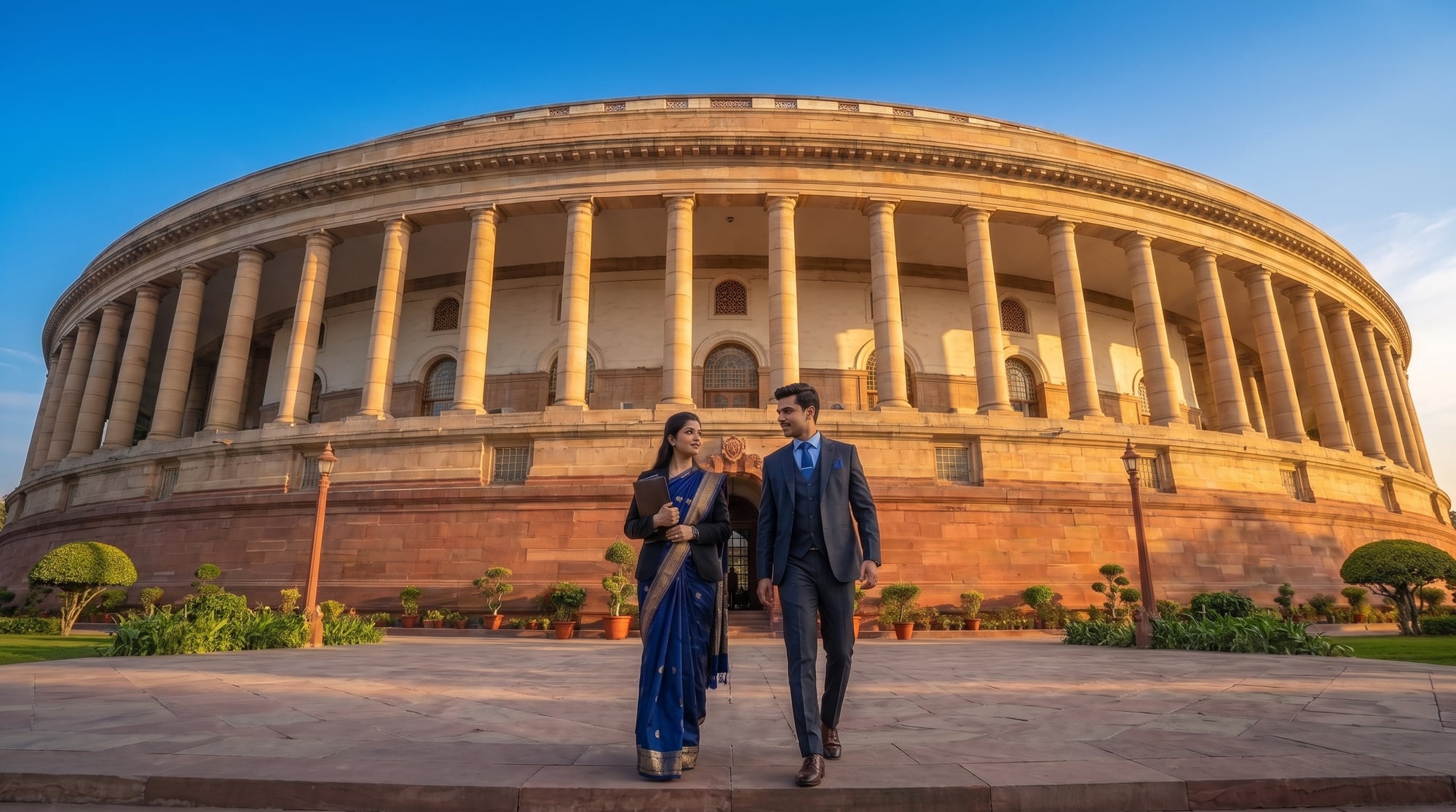
India’s federal structure rests on a decentralized framework wherein the national assembly and state assembly elections are held separately in a staggered manner. Implementing the proposed 'One Nation, One Election' model would trigger a profound political and constitutional shift. The proposal for it came into prominence and was institutionalized on release of the Kovind Committee Report of 2024, which laid down the fiscal and logistical benefits of simultaneous elections of national assembly as well as state assemblies. The JPC mentioned savings of ₨. 7 Lakh crores from public ex-chequer per election cycle.
The academic argument in favour of ‘ONOE’ posits that polity supersedes policy in India. Elections, interstate & state level politics in India manages to garner a lot of mainstream attention in the media cycle and mindshare from the voters. Proponents argue that shifting to simultaneous elections will realign mainstream public discourse toward localized governance and structural policymaking at both the state and national levels. Consequently, constituencylevel issues could be debated constructively within the digital economy, rather than being sidelined by perpetual campaign rhetoric. The country goes into election mode every year with some state assemblies going into elections. This creates a policy paralysis due to implementation of Model Code of Conduct which halts any new policy or project to be announced. Imposition of MCC halts the infrastructure capex and mobility restrictions in the states. This halt puts brakes on the Indian economy. In case of simultaneous elections when the state level governments are confident about stable majority and election cycle, there is far more room for them to flex muscles on policy front and capital expenditure which boosts investor confidence. The arguments in favour of simultaneous election of fiscal front are too good to assume as they are mainly based on a mathematical model that involve a lot of variables when they are actually factored in.
The arguments that are presented against polarization focus on that broad strokes of national agendas will take over the regional/state level issue salience. The current opposition party alliances fear a narrative domination around the national issues in the voting class. They also fear that in the model of simultaneous elections the regional parties would compromise on their identities and eventually would have to fight for their existence. The model of simultaneous elections also poses a risk for coattail effects where lower-level candidates of a bigger national party are pulled into the victory camp by sheer likeness for the national level candidates. The claim from the simultaneous election proponents is that this model reduces governance and policy disruption without altering the electoral outcomes. However (Singh, 2026)’s journal article which described variance of vote share difference between states dominated by regional parties from 1967(year when last simultaneous elections were conducted) and the next elections which where staggered elections for national and state assembly respectively, it shows by DiD estimate (Difference-in-Differences) that regional parties managed to gain an increased vote share in the years when staggered elections took place, in states where they have their organisational base.
Congress
UP – SSP 18.6 22.1 14.3 19.8 +1.2 Maharashtra 7.2 11.4 5.4 12.9 +3.3* – PWP Rajasthan– 14.1 17.3 9.8 14.2
Source: ECI Statistical Reports. DiD = (VS%₇₂ – LS%₇₂) – (VS%₆₇ – LS%₆₇). * p < 0.05
The arguments against simultaneous complains about the compromise of India’s federal structure and aims to bring centralization of power to the central government. It undoes the efforts of federalisation of done through 1990’s where state governments were given a lot of regional autonomy and power. The cognitive load on voter minds may discourage them for ticket splitting and they may end up choosing similar party candidates on both the levels (Singh, 2026, p. 1558 ).
Simultaneous election may rob citizens of opportunity for democratic course correction as it was seen in the last national assembly elections of 2024 where NDA’s vote share in Hindi heartland of Uttar Pradesh and Haryana went down contrary to the last and next Vidhan Sabha election in these states, where they managed comfortable victories. This shows that voters have the capability to show disappointment through polling booths in simultaneous elections. In (Mishra, 2026), the authors tell us about the difference in GSDP (Gross state domestic product) of the states that go into simultaneous elections. Currently 7 states, and 1 UT of which 4 held simultaneous elections and 3 states held elections in the same year as national elections. The states going in simultaneous elections reported a higher GSDP.
FINAL THOUGHTS...
The economic or fiscal arguments coupled with logistical arguments for the model of simultaneous elections seem to weight off the compromises made for it, which can be solved with mutual cooperation amongst political parties for the greater good of the nation. It can be implemented without hampering the growth of state legislatures and can be mitigated by installing structural guardrails for the political campaigns, a mandatory ‘State Issue Period’ where national candidates appearances are restricted in states. This would give local governance salience a voice amidst the simultaneous model. A different coloured polling booths for states and national polls. India would be the amongst the first major democracy to go into simultaneous elections as countries that have this in place (Sweden, South Africa, Belgium) have proportional representation electoral system unlike India’s ‘First Past the Post’.
In my opinion the regional parties have much more to gain contrary to national parties, for whom stakes will be much higher. In current landscapes of India with 2 coalition political outfits, the regional parties will have much more bargaining power in their respective alliances. The model of ‘One Nation Two Elections’ sounds much more plausible as resource mobilisation, energy demands & security personnel already a challenge in India. India’s policeto-population ratio hovers around 153 per 1,00,000 citizens, way below prescribed levels, which can come as challenge in regionally sensitive to violence areas.
References
Mishra, P. M. (2026, Jan 30). All the Growth We Cannot See: Staggered Elections in World’s Largest Democracy. 60.
Singh, G. (2026, 06 03). Electoral Behaviour Under Simultaneous Elections in India: A Comparative Analysis of National and Regional Voting Preferences Within the One Nation, One Election Framework. International Journal of Research & Technology, 1550-1563. Retrieved 07 15, 2026, from https://ijrt.org/j/article/view/1493